Driving License
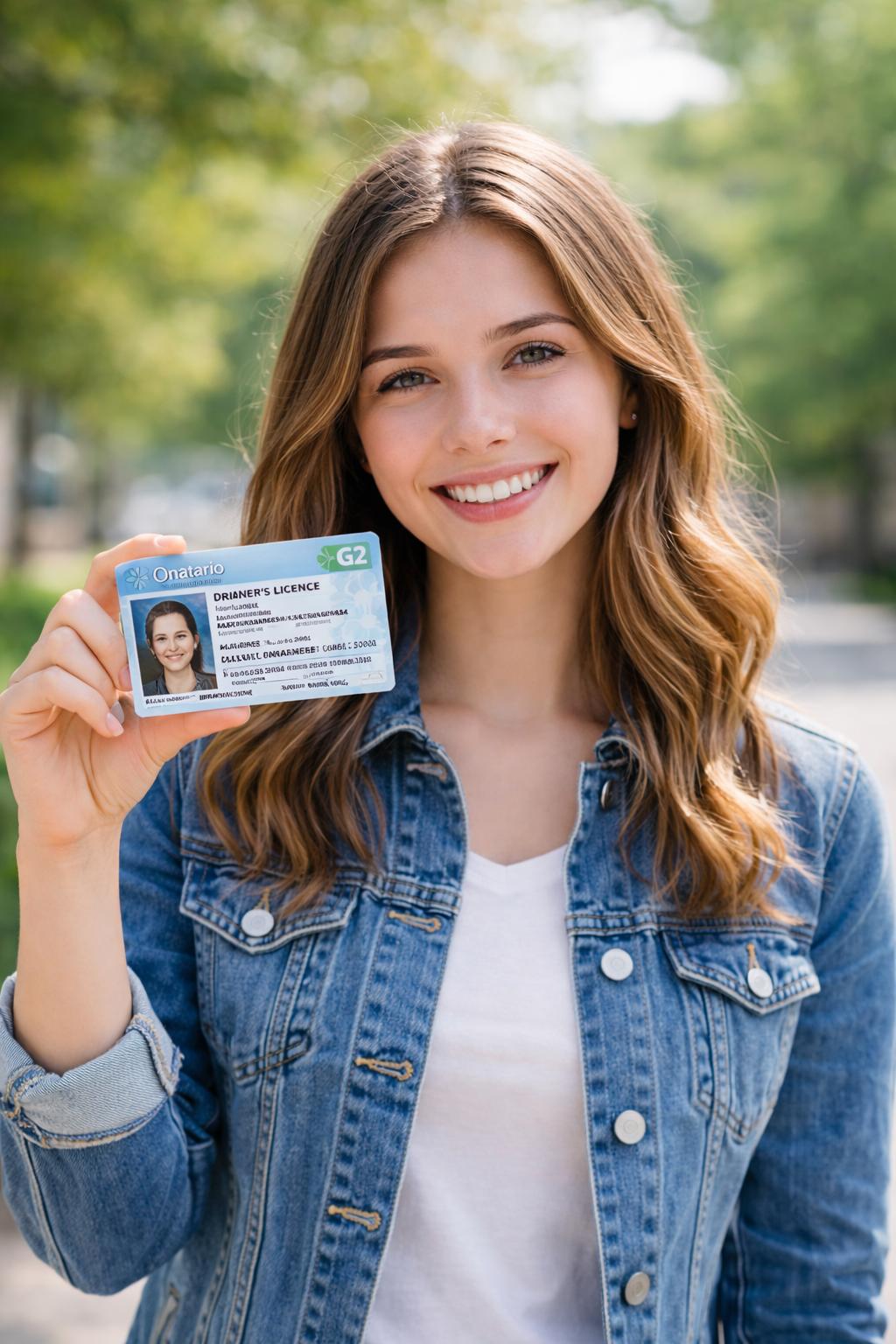
To get a license in Ontario, you must be at least 16 years of age. Graduated licensing was introduced in Ontario in April 1994. In order to get your license you need to go through three stages.
In the first stage you obtain a Driver’s handbook which is available at any book store,convience store, MTO center and also at various other locations. Then, on or after your 16th birthday and once you have studied the handbook, you can go to a Ministry of Transportation office nearest you and write a theoretical G1 exam. You must bring $125.00 and 2 pieces of ID with you. Once you pass the exam, you will be given a G1 license and you will be eligible to do a practical road test one year from that date.
- Under a G1 license, many conditions apply which are designed to help you gain experience before you can actually do your road test. These are discussed below and are also covered in the drivers handbook.
- Anytime you are behind the wheel, you must be accompanied by a driver who has at least 4 years of G class driving experience.
- You are prohibited from driving from 12 am to 5 am in the morning.
- You are prohibited from driving on any highways with posted speed limits of 80 km or above including all the any of the 400 series highways, unless you are accompanied by a licensed driving instructor.
- You must maintain a blood alcohol level of 0.00% at all times.
- You must not have more passengers in your car than the seat belts.
After getting a G1 permit, if you attend an approved driving course such as ours, you are eligible to reduce the waiting period for your first road test from 12 months to 8 months. At the end of this waiting period you can go for your first road test.
Once you have passed the first road test at the end of 8 or 12 months, you are given a G2 license. There are some conditions here but far fewer when compared with G1 conditions. These are discussed below and are also covered in the driver’s handbook.
- You must maintain a blood alcohol level of 0.00% at all times.
- You must not have more passengers in your car than the seat belts.
Defensive Driving Theory Course Outline
The following is a brief summary of the various topics covered by all of our Full Defensive Driver Training Courses (classroom theory portion).
Introduction & Basics
This section covers many common misconceptions regarding everyday traffic situations and driving in general. After completing this introductory section, students should know all pertinent information regarding acquiring a learner’s licensce, as well as the basic framework for the Smith System of Defensive Driving.
Road Signs, Lines and Traffic Controls
An explanation of shapes and colors of road signs along with a discussion of each particular sign and a short video presentation to familiarize students with the different sign catagories. Also discussed are the consequences of failing to obey specific road signs.
Safety Devices
A discussion about seat-belts, child seats, airbags and other safety features which, when used consistently save lives.
The Smith System
The Smith System is the industry standard in defensive driver training systems. It consists of the “Five Keys to Space Cushion Driving.” This program covers improving driver perception to create safer drivers, keeping space around your vehicle (no more ‘traffic roulette’,) what good driving practices are, creating good seeing habits and improving driver visibility.
Hazard Recognition, Perception and Management: Students learn to identify hazards and discuss ways to manage them so that they are no longer hazards to them on the road.
City Driving
Discussed are merging and merge lanes, rights of way, uncontrolled intersections, pedestrian hazards, buses, parking, signalling, traffic congestion, traffic tempo, one-way streets and traffic patterns. Additionally, many other dangers of city driving are investigated and discussed by the students.
Driving with Fuel Efficiency: In the interests of environmental awareness, a discussion regarding methods of driving economically and areas in which students can improve their efficiency as it relates to their tires, brakes, fuel and wearable moving parts.
Impaired Driving
The effects of drinking and drugs on a driver’s abilities, reaction times and decision-making abilities and the responsibilities of drivers as road-users. Included is a frank, open discussion and videos about these serious topics. Also discovered are the ways that things like stress, anger and fatigue can impair driving ability.
Avoiding Collisions
Lecture and Discussion on collision avoidance techniques and the skills necessary to avoid putting yourself into a position where you are in danger of a collision. Students learn to be Pro-active in their driving and to practice the See-Think- Do methods which keep them out of trouble in the first place.
Driver Attitudes
Students discover how their attitudes towards driving develop through outside influences such as peer pressure, advertising, etc and discuss ways to have a better driving attitude.
Adverse Driving Conditions
Weather, road conditions, night driving and other situations are discussed and students learn ways to drive more safely and effectively in them. We also discuss ways to deal with emergency situations as they occur during driving.
Freeway and Highway Driving
Methods for safe entry and exit onto freeways and highways are discussed. The use of HOV lanes are covered in this segment.
Road-Test
Being prepared and feeling confident for the government road-test. We cover all of the requirements to being successful the first time.
This is only a brief overview of a few of the life-saving concepts that we teach in our Defensive Driver Training programs.
Emergency Maneuver Package
Here at CS Driving school we like to ensure that our students get the best in quality during their on the road training session. To ensure their safety on the road we offer an emergency maneuver package to go along with the basic 10 hours that is offered with the standard course. We are the only school besides young drivers of Canada that offer this option to their students. the package will involve 2 full hours of instruction that will cover the following maneuvers:
Gravel Shoulder Recovery
Student must learn to recover and control vehicle if it drifts onto a gravel shoulder.
Head On Avoidance
Same as above, yet in this maneuver the students are taught how to avoid car passing from opposite lane in to their lane. This will allow the student to prevent and avoid a head on collision
Rear Crash Avoidance
Student is taught how to respond correctly to a car that is about to hit them from behind. Emphasis is placed on hand over hand steering and also on being aware of their blind spots.
Avoidance Swerving
Student is taught to respond correctly to an object that has just fallen into their path at 40km/h. Emphasis is placed on proper steering and eyes ahead, always looking into their space on the road and where they want to go.
Threshold Braking/ ABS Emergency Stop
The object of the procedure is to have the student stop as soon as possible using the best braking procedure without the brakes locking up. Avoiding locking of the brakes will prevent the car from sliding and also will stop the car more quickly and efficiently.
With this maneuver student are still using the threshold braking technique, But you are now approaching the object pylons as at faster speed (60 km/h) and will not able to stop in time , therefore to avoid hitting object you must pick and escape route of the time (Left or Right ) and swerve.
Trained professional teAch all of our session. Most of the lesson will be given in a parking lot using pylons as obstacles in driver way yet, gravel shoulder recovery will be though the road ONLY when it safe to do so . The cost of the package is $200 + HST and it will cover all the basic maneuvers mentioned above.
We stress that every student consider putting extra in the extra time and money to learn these procedures because it could help them become a more safe and cautious driver. All fees for this package should be paid in advance in order to help us serve you better. Please fill the bottom portion with your name and signature; student under 18 should also have their parent / guardian sign below. If you feel like you want this emergency maneuver package check the box below.
Emergency Maneuver Package
CS Driving school.
Stoney Creek:
905 923 4412